
Improving Ocean Literacy
What is Ocean Literacy?
Ocean literacy is most simply defined as understanding your influence on the ocean and its influence on you.
Developed in the early 2000s, the term was coined by marine educators who recognised a lack of inclusion of ocean science within the national curriculum. With an original aim of enhancing ocean knowledge in school students, ocean literacy began as a concept with its foundations in formal education.
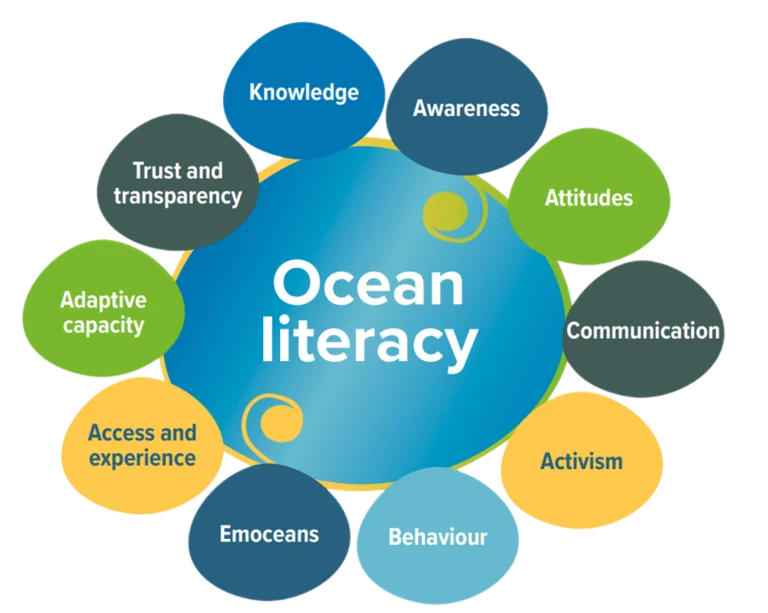
However, more recently, our understanding of human behaviour and ocean literacy has evolved. Recent research has highlighted that there are many aspects to ocean literacy including awareness, attitudes, ‘emoceans’, access and experience, adaptive capacity, and trust and transparency. We now focus on 10 dimensions of ocean literacy, recognising the diversity of relationships that can be held between people and the sea.
Why Ocean Literacy?
The more connected people feel to the sea, the more conscious they become about their individual and societal effects on marine and coastal environments. This can lead to behavioural changes that safeguard and protect these important natural spaces as well as all the benefits they provide.
Ocean literate individuals, businesses and policy makers have a key part to play in ensuring we have resilient seas and thriving coastal communities.
Welsh Ocean Literacy Coalition
Established by the Wales Coasts and Seas Partnership (CaSP Cymru) in 2022, the Welsh Ocean Literacy Coalition (WOLC) launched ‘Y Môr a Ni’ (‘The Sea and Us’) – a framework for Ocean Literacy in Wales.
WOLC combines the knowledge and experience of organisations from across the marine sector (and beyond!) including Natural Resources Wales, Welsh Government, The Marine Conservation Society, Cardiff University and North Wales Wildlife Trust, and looks to build awareness of our influence on the sea and the sea’s influence on us.
It has a growing and diverse membership of marine and coastal practitioners and meets four times per year to share experience and learning across a range of work to engage communities, businesses, and organisations on marine and coastal issues.
If you are interested in getting involved in WOLC, contact Reece Halstead on reece.halstead@northwaleswildlifetrust.org.uk